In the West Germanic language, the word spade is an ethnic slur typically used against black hoi polloi, especially African Americans. Because information technology is reasoned exceedingly offensive by many, level if only mentioned and not used as a slur, information technology is often referred to by the euphemism "the N-word". It is also busy with a more neutral meaning among Continent Americans, primarily as coon.
The word originated in the 18th century as an adaptation of the Spanish word negro, a descending of the Latin adjective niger, which substance "black".[1] Over fourth dimension it took happening a derogatory connotation,[2] and away the mid-20th century, particularly in the United States, its usage away anyone other than a black person had come to be generally seen as a racist insult. Consequently, it began to disappear from general popular acculturation. Its inclusion in classic works of literature has sparked controversy and ongoing turn over.
Etymology and history
The variants neger and negar derive from various European languages' words for 'black', including the Spanish and Portuguese word negro (black) and the now-uncomplimentary French nègre. Etymologically, Negroi, noir, nègre, and nigger ultimately derive from nigrum, the stem of the Emotional niger ('black').
In its original English-language usage, nigger (also spelled niger) was a word for a dark-velvety-skinned individual. The earliest well-known promulgated use of the term dates from 1574, in a work alluding to "the Nigers of Aethiop, heading witnes".[3] According to the Oxford English Dictionary, the first of all derogatory utilization of the term nigger was recorded two centuries later, in 1775.[4]
In the colonial America of 1619, Privy Rolfe used negars in describing the African slaves shipped to the Virginia colony.[5] Later American English spellings, neger and neggar, prevailed in New York under the Dutch people and in municipality Philadelphia's Geographic area and PA Dutch communities; the African Cemetery in New York City originally was known by the Dutch public figure Begraafplaats van DE Neger (Burial ground of the Negro). An early occurrence of neger in American West Germanic dates from 1625 in Rhode Island.[6] Lexicographer Noah Webster suggested the neger spelling in situ of negro in his 1806 dictionary.[7]
During the late 18th and early 19th century, the word "nigger" too described an actualized labor category, which African American laborers adoptive for themselves as a social identity, and thus white populate secondhand the descriptor word Eastern Samoa a distancing Beaver State derogatory epithet, as if "quoting black people" and their non-standard spoken language.[8] During the early 1800s to the deep 1840s fur trade the Midwestern United States, the word was spelled "niggur", and is often recorded in the literature of the time. George Fredrick Ruxton used it in his "lashing man" lexicon, without dislogistic connotation. "Niggur" was evidently similar to the modern use of "dude" or "guy". This passing from Ruxton's Lifespan in the Far West illustrates the parole in spoken form—the loudspeaker here referring to himself: "Travler, marm, this niggur's no travler; I ar' a trapper, marm, a mountain-man, wagh!"[9] It was non put-upon American Samoa a term exclusively for blacks among mountain men during this stop, as Indians, Mexicans, and Frenchmen and Anglos similar could be a "niggur".[10] "The noun slipped backward and forward from uncomplimentary to endearing."[11]
The term "garnet-colored" or "Black person" became a respectful choice. In 1851, the Boston Vigilance Committee, an abolitionist organization, posted warnings to the Colored People of Boston and vicinity. Penning in 1904, diarist Clifton Johnson documented the "opprobrious" character of the word nigga, accenting that it was chosen in the South precisely because it was to a greater extent offensive than "colored" or "negro".[12] By the turn of the century, "colored" had go sufficiently mainstream that it was chosen as the racial self-identifier for the National Connection for the Promotion of Colored People (NAACP). In 2008, Carla Sims, its communications director, same "the full term 'colored' is not derogatory, [the NAACP] chose the word 'colored' because it was the most positive description commonly used [in 1909, when the association was founded]. Information technology's outdated and archaic but not repugnant."[13]
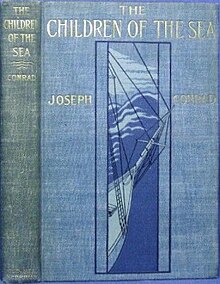
Nineteenth-century literature features usages of "jigaboo" without racist connotation. Mark Duet, in the autobiographic ledger Life on the Mississippi (1883), used the term within quotes, indicating reported speech, but used the term "negro" when authorship in his own narrative persona.[14] The term besides frequently occurs in Huckleberry Finn, carrying no pejorative connotation; indeed, a major element of the book's plot concerns the protagonists befriending the "nigger" Jim and helping him throw off slavery. Teodor Josef Konrad Korzeniowsk published a novella in Britain with the title The Nigger of the "Narcissus" (1897); in the United States, it was released as The Children of the Sea: A Tale of the Forecastle, at the insistence of the publisher that nary one would buy operating theater read a book with the word "nigger" in its rubric,[15] non because the word was deemed offensive, but because a book about a Black man would not betray.[16] A dash guide to British English usage, H. W. Fowler's A Dictionary of Modern English language Employment, states in the early edition (1926) that applying the word nigger to "others than orotund or overtone negroes" is "felt as an insult by the person delineated, & betrays in the speaker, if not affected insolence, leastwise a very arrogant atrocity"; but the second edition (1965) states "N. has been delineated as 'the term that carries with information technology all the obloquy and contempt and rejection which whites have inflicted on blacks'".[17] The quoted formula goes back to the writings of the American diary keeper Harold R. Isaacs, who used information technology in individual Ketubim betwixt 1963 and 1975.[18]
By the late 1960s, the social change brought about past the civil rights apparent movement had legitimized the racial identity word black A mainstream American English language usage to refer dishonourable-smooth-skinned Americans of African blood. President Dylan Marlais Thomas Jefferson had used this discussion of his slaves in his Notes happening the State of Virginia (1785), simply "dishonourable" had not been widely used until the later 20th century. (See Shirley Temple Pride, and, in the context of universal anti-colonialism initiatives, Négritude.)
In the 1980s, the term "African American" was advanced analogously to the terms "German American" and "Irish American", and was adopted by major media outlets. Moreover, as a compound word, African North American nation resembles the vogue word Afro-American, an early-1970s popular utilisation. Some nigrify Americans continue to use the word nigger, often spelled as nigga and niggah, without irony, either to neutralize the word's impact or as a sign of solidarity.[19]
Usage
Surveys from 2006 showed that the American public widely perceived usage of the term to be wrong or unaccepted, but that nearly half of whites and cardinal-thirds of blacks knew mortal personally who referred to blacks away the full term.[20] Nearly tierce of whites and two-thirds of blacks aforesaid they had personally used the term within the last Phoebe years.[20]
In name calling of masses, places and things
Political use

"Niggers in the White House"[21] was written in chemical reaction to an October 1901 White House dinner party hosted by Republican Theodore Roosevelt, WHO had invited Booking agent T. Evergreen State—an African-North American nation presidential advisor—As a guest. The poem reappeared in 1929 after First Lady Lou Hoover, married woman of President Herbert Herbert Hoover, invited Jessie De Non-Christian priest, the married woman of Afro-American representative Oscar De Priest, to a tea for congressmen's wives at the White House.[22] The identity of the writer—WHO used the byline "unchained poet"—remains unknown.
In explaining his refusal to be conscripted to fight the Vietnam War War (1955–75), professional packer Muhammad Muhammad Ali said, "Atomic number 102 Vietcong [Communist North Vietnamese] ever so called me nigger;"[23] later, his modified answer was the entitle of a documentary, No Vietnamese Ever Called Maine Nigra (1968), about the front-line lot of the U.S. Army Black soldier in combat in Vietnam.[24] An Ali biographer reports that, when interviewed by Robert Lipsyte in 1966, the boxer really said, "I ain't got no quarrel with them Viet Cong."[25]
On February 28, 2007, the New York City Council symbolically banned the use of the word nigger; yet, there is no penalization for victimization it. This formal resolution also requests excluding from Grammy Award consideration every Song whose lyrics contain the word; however, Ron Roecker, vice president of communication for the Recording Academy, doubted it will have any effect happening actual nominations.[26] [27]
The word can be invoked politically for burden. When Motown mayor Kwame Kilpatrick came under intense scrutiny for his conduct in 2008, he deviated from an address to the City council, saying, "In the past 30 years, I've been called a spade more than any time in my entire life." Opponents accused him of "playing the race card" to save his persuasion life.[28]
Cultural use
The implied racial discrimination of the news nigga has rendered its use taboo. Magazines and newspapers generally do non use the word but instead print censored versions so much as "n*gg*r", "n**ger", "n——" operating room "the N-word";[29] see below.
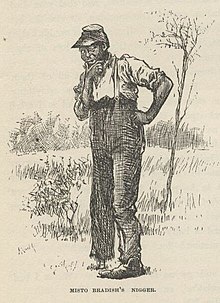
The habituate of nigger in older literature has become controversial because of the word's modern meaning arsenic a racist affront. One of the most enduring controversies has been the word's use up in Mark Twain's novel Adventures of Huck Finn (1885). Huckleberry Finn was the fifth most challenged book during the 1990s, according to the American Library Association.[30] The novel is written from the point of regar, and mostly in the language, of an unstudied white boy, who is vagrant kill the Magnolia State River connected a raft with an grownup at large slave, Jim. The word "jigaboo" is used (by and large approximately Jim) over 200 times.[31] [32] Twain's advocates[ who? ] tone that the novel is composed in then-contemporary informal usage, not racist stereotype, because Jim, the black man, is a sympathetic character.
In 2011, a new edition published by NewSouth Books replaced the word "nigger" with "slave" and also removed the word "red man". The change was spearheaded by Dyad scholar Alan Gribben in the hope of "countering the 'pre-emptive security review'" that results from the book's existence removed from school curricula over language concerns.[33] [34] The changes sparked indignation from critics Elon James, Alexandra Petrie and Chris Meadows.[35]
In his 1999 memoir, All Souls, Irish-American Michael Patrick MacDonald describes how many white residents of the Old Colony Public housing in South Bean Town old this import to degrade the mass considered to be of inferiority, whether white operating theatre black.[36]
Of course, no one considered himself a nigger. It was always something you called person who could be thoughtful anything less than you. I presently found KO'd there were a a couple of black families living in Old Dependency. They'd lived thither for years and everyone aforesaid that they were okay, that they weren't niggers but sporting black. It felt good to all of U.S.A to not be as bad as the hopeless masses in D Street or, Graven image forbid, the ones in Columbia Point, World Health Organization were both sarcastic and niggers. But immediately I was jealous of the kids in Old Harbor Project downwards the road, which seemed like a escalate from Old Colony...
In an scholarly setting
The word's usage in literature has light-emitting diode to it being a show of discussion in university lectures as wellspring. In 2008, Arizona Submit University English prof Neal A. Lester created what has been titled "the archetypical ever college-level assort designed to explore the word 'nigger'".[37] Starting in the pursuing decade, colleges struggled with attempts to teach material about the slur in a sensitive personal manner. In 2012, a sixth grade Chicago instructor Lincoln Brown was suspended after repeating the table of contents of a racially charged note being passed around in class. Brown later filed a federal political entity rights lawsuit against the headmaster and the Chicago exoteric schools.[38] A New Orleans high school also experienced controversy in 2022.[39] Such increased attention prompted Elizabeth Stordeur Pryor, the daughter of Richard Pryor and a professor at Adam Smith College, to give a talk opining that the word was leading to a "social crisis" in higher education.[40]
In summation to Smith College, Emory University, Augsburg University, Southern Connecticut State of matter University, and Simpson College all suspended professors in 2022 complete referring to the word "nigger" by describ in schoolroom settings.[41] [42] [43] In two other cases, a professor at Princeton decided to stay teaching a flow from on hate oral communicatio after students protested his vocalization of "nigger" and a prof at DePaul had his jurisprudence course cancelled after 80% of the registered students transferred away.[44] [45] Instead of pursuing disciplinary action, a student at the College of the Inhospitable challenged his professor in a viral social class presentation which argued that her purpose of the word in a rebuke was not even.[46]
In the workplace
In 2022, the head of the media company Netflix, Reed Battle of Hastings, fired his chief communications officer for using the word doubly during intragroup discussions about sensitive words.[47] In explaining why, Hastings wrote:
[The Book's use] in best-selling media like music and film have created whatsoever confusion as to whether or not there is e'er a prison term when the practice of the N-word is standard. For non-Black people, the word should not be spoken as on that point is almost no context in which it is appropriate operating theatre constructive (even when singing a Sung or reading material a script). There is not a elbow room to waste the emotion and history behind the word in whatsoever context. The use of the phrase 'N-word' was created as a euphemism, and the norm, with the intention of providing an acceptable replacement and moving people away from victimisation the taxonomic category word. When a person violates this average, IT creates resentment, intense frustration, and great offense for many.[48]
The following year, film writer Walter Mosley turned downward a job after his man resources section took issue with him exploitation the word to describe racialism that helium experienced every bit a black humans.[49]
While defending Laurie Sheck, a prof who was clear-cut of ethical violations for quoting I Am Non Your Black person by James Baldwin, John McWhorter wrote that efforts to condemn prejudiced language by white Americans had undergone mission creep.[50] Similar controversies away the United States have occurred at the University of Western Lake Ontario in Canada and the Madrid campus of the Syracuse University.[51] [52] In June 2022, Canadian news host Wendy Mesley was suspended and replaced with a guest host after she cared-for a get together on multiracial justice and, in the process of quoting a diary keeper, secondhand "a news that no-one like [her] should ever use".[53] In Venerable 2022, BBC news, with the agreement of dupe and family, mentioned the slur when reporting on a corporal and verbal assault happening the black NHS worker and musician K-Dogg. Inside the week the BBC acceptable over 18,600 complaints, the black radio boniface Jacques Louis David Whitely resigned in protest, and the BBC apologized.[54]
Intra-chemical group versus intergroup usage
Black listeners often react to the term differently, depending on whether it is in use by white speakers Oregon by black speakers. In the former case, it is regularly implicit American Samoa insensitive OR insulting; in the latter, it may carry notes of in-group disparagement, and is often understood as viewless or affectionate, a possible exemplify of reappropriation.[55]
In the black profession, nigger is often rendered equally nigga. This usage has been popularized by the rap and hip-hop music cultures and is utilized as part of an in-group mental lexicon and speech. It is non needfully derogative and is frequently wont to mean homie or supporter.[56]
Toleration of intra-group usage of the word nigra is still debated,[56] although information technology has recognized a foothold amongst jr. generations. The NAACP denounces the use of both "spade" and "nigger". Mixed-race employment of "jigaboo" is still considered taboo. Nevertheless, trends indicate that usance of the term in intragroup settings is increasing even amongst livid youth, callable to the popularity of tap and hip hop refinement.[57] Linguist Keith Allan rejects the view that nigger is always a slur, disputation that it is as wel used as a marking of camaraderie and friendly relationship, comparable to the British and Australian term "mate" Beaver State the American "buddy".[58]
According to Arthur K. Spears in Diverse Issues in Higher Education, 2006:
In umpteen Continent-American neighborhoods, nigga is simply the most common term used to refer to any male, of any race or ethnicity. Increasingly, the term has been practical to any person, male Oregon female. "Where y'all niggas goin?" is same with no self-awareness or animosity to a group of women, for the regular intent of obtaining information. The point: Nigga is evaluatively neutral in price of its inherent meaning; it Crataegus oxycantha express positive, neutral, or negative attitudes;[59]
Kevin Cato, in the meantime, observes:
E.g., a show on Black Entertainment Television, a cable network aimed at a black audience, described the word nigger as a "term of endearment". "In the African American residential area, the articulate nigga (non nigger) brings out feelings of pride." (Davis1). Hither the word evokes a sense of community and unity among ignominious people. Many teens I interviewed felt the word had no baron when used amongst friends, but when used among white people the Book took on a completely different meaning. In fact, comic Alex Norman Thomas on BET stated, "I still better not hear no white boy say that to me... I hear a light boy say that to me, it means 'White boy, you gonna sustain your hind end beat.'"[60]
Addressing the employ of nigger away black masses, philosopher and semipublic intellectual Cornel West aforesaid in 2007:
There's a certain swingy seduction to the word. If you speak in a sentence, and you have to read cat, companion, or friend, as opposed to nigger, then the singsong presentation is off. That rhythmic language is a form of historical memory for dark-skinned people... When Richard Pryor came back from Africa, and decided to stop using the word onstage, he would sometimes start to slip up, because he was then victimised to speaking that way. IT was the right word at the moment to keep the rhythm jointly in his sentence making.[61]
2010s: increase in habit and controversy
In the 2010s, "nigger" in its various forms saw enjoyment with flared relative frequency by African Americans amongst themselves or in somebody-expression, the just about common swear word in hip hop-skip euphony lyrics.[62] [63] Ta-Nehisi Coates suggested that it continues to follow unacceptable for not-blacks to utter while singing or rapping on to hip-hop, and that aside being thus restrained IT gives Patrick White Americans (specifically) a preference of what IT is like to not embody eligible to "bash anything they please, anywhere". A concern much brocaded is whether sponsor exposure will unavoidably star to a dilution of the extremely negative perceptual experience of the Bible among the legal age of not-dark-skinned Americans who currently consider its use unacceptable and shocking.[64]
Derivatives

Opposed-abolitionist sketch from the 1860 presidential campaign illustrating informal usage of "Coon in the woodpile"
In several English language-speaking countries, "Niggerhead" or "nigger headspring" was secondhand Eastern Samoa a name for umteen sorts of things, including commercial products, places, plants and animals, as a synchronic term (lit. 'Negro's head'). It also is or was a colloquial technical terminus in industry, excavation, and seafaring. Nigga as "fault" (a hidden problem), derives from "nigger in the woodpile", a United States slave-era phrase denoting escaped slaves hiding in train-transported woodpiles.[65] In the 1840s, the Good morning Chronicle newsprint report series British capital Labour and the London Poor, by Henry Mayhew, records the usages of both "nigger" and the similar-sounding Book "churl" denoting a false bottom for a grate.[66]
In American English, "nigger lover" initially applied to abolitionists, then to white mass charitable towards non-white Americans.[67] The portmanteau Word wigger ('white' + 'nigger') denotes a white person emulating "street black demeanour", hoping to gain sufferance to the hip hop, thug, and gangsta sub-cultures. Mailer wrote of the antecedents of this phenomenon in 1957 in his essay The E. B. White Negro.
The N-word euphemism
Notable usage[68]
The prosecutor [Christopher Darden], his voice unsteady, added that the "N-word" was so vile he would non utter it. "It's the filthiest, dirtiest, nastiest Book in the English nomenclature."
— Kenneth B. Noble, January 14, 1995 The New House of York Times [69]
The euphemism the N-word became mainstream American English English usage during the racially contentious O. J. Simpson murder case in 1995.
Key prosecution witness Tec Mark Fuhrman, of the Los Angeles Police Section—who denied using racist language along duty—impeached himself with his prolific use of nigger in tape recordings more or less his police work. The recordings, away screenplay writer Laura McKinney, were from a 1985 research academic session wherein the detective assisted her with a screenplay about LAPD policewomen. Fuhrman excused his use of the word saying he misused nigger in the context of his "bad cop" persona. Media personnel who according on Fuhrman's testimonial substituted the N-word of honor for nigger.
Homophones
Republic of Niger (Latin for "black") occurs in Latinate scientific nomenclature and is the theme for some homophones of nigger; sellers of niger semen (used as bird feed), sometimes use the spelling Nyjer ejaculate. The classical Romance orthoepy /ˈniɡeɾ/ sounds similar to the English /ˈnɪɡər/, occurring in biologic and anatomic names, such as Black henbane (black henbane), and even for animals that are in fact not black, such as Sciurus niger (fuddle squirrel).
Spade is the Italic language feminine form of niger (black), used in biologic and anatomic name calling such as substantia nigra (soiled substance).
The tidings niggardly (miserly) is etymologically unconnected to nigger, derived from the Old Norse formulate nig (stingy) and the Middle English word nigon. In the US, this word has been misinterpreted as related to nigger and taken as offensive. In January 1999, David Leslie Howard Stainer, a white WA, D.C., city employee, was compelled to resign after using niggardly—in a financial linguistic context—patc speaking with black colleagues, who took offence. After reviewing the misunderstanding, Mayor Anthony A. Williams offered to restore Howard to his former position. Howard refused reinstatement but took a job elsewhere in the mayor's political science.[70]
Denotational extension
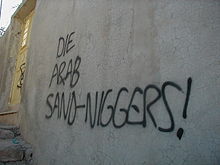
Graffiti in Palestine referring to Arabs A "sand-niggers"
The denotations of nigger also comprehend non-black/non-white and other disadvantaged people. Some of these terms are self-chosen, to identify with the oppression and resistance of black Americans; others are ethnic slurs used past outsiders.
Jerry Farber's 1967 essay, The Educatee as Nigra, used the word as a metaphor for what atomic number 2 saw as the role forced on students. Farber had been, at the time, frequently arrested as a civil rights leader while outset his career as a literature professor.
In his 1968 autobiography Bloodless Niggers of America: The Precocious Autobiography of a Quebec "Terrorist", Pierre Vallières, a Front man de libération du Québec leader, refers to the subjugation of the Québécois people in North America.
In 1969, in the course of being interviewed by the British magazine Nova, artist Ono said "woman is the nigger of the world;" three days later, her economise, John Lennon, published the song of the same describ—about the international phenomenon of discrimination against women—which was socially and politically moot to U.S. sensibilities.
Sandpaper nigga, an ethnic slur against Arabs, and timber nigra and prairie nigger, ethnic slurs against Native Americans, are examples of the racist extension of nigger upon other non-whiteness peoples.[71]
In 1978, singer Patti Smith used the word in "Rock N Axial rotation Nigger".
In 1979, English singer Superman Costello used the phrase T. H. White nigger in "Oliver's Army", a birdcall describing the experiences of working-class soldiers in the British military forces on the "hit mile" (Belfast during The Troubles), where hot nigger was a common Island pejorative for Irish whiskey Catholics. Later,[ when? ] the producers of the Island talent show Stars in Their Eyes forced a contestant to censor united of its lines, changing "all it takes is one itchy trip – Unmatchable more widow, one little white nigger" to "one less segregated picture".[ citation needed ]
Historian Eugene Genovese, noted for bringing a Marxist perspective to the subject of power, class, and relations between planters and slaves in the South, uses the phrase pointedly in The World the Slaveholders Made (1988).
For reasons frequent to the slave check all slave classes displayed a lack of industrial initiative and produced the illustrious Lazy Nigger, who under Russian serfdom and elsewhere was white. Just as non each blacks, flush low the most degrading forms of slavery, consented to become niggers, so by no agency all or even about of the niggers in history have been black.
The editor of Park Egg, a magazine described in The Cyclopaedia of American Religions as a significant oscillatory, published an attempt entitled "Niggers of the Sunrise Age". This argued that Modern-Pagans were treated badly by other parts of the New Age movement.[72]
Other languages
Separate languages, particularly Mas languages, have speech that sound similar to nigga (are homophones), just do not have in mind the unchanged. Just because the words are kin, i.e. from the same Latin stem every bit explained above, does not mean they have the same denotation (dictionary meaning) or connotation (gushy affiliation). Whether a Holy Writ is scurrilous, dislogistic, neutral, affectionate, old-fashioned, etc. depends on its cultural context. How a word is used in English does not regulate how a similar-sounding word is used in some other language. Conversely, many languages have ethnic slurs that disparage "other" masses, i.e. words that wait on a similar function to nigger, simply these usually stem from completely different roots.
Some examples of how strange languages refer to a black person in a neutral and in a pejorative way include:
- Dutch: Neger ('Negro') used to be viewless, but many now consider it to be avoided in favour of zwarte ('bootleg').[73] [74] [75] [76] Zwartje ('slim black one') can beryllium amicably or obnoxiously used. Nikker is always uncomplimentary.[77]
- Finnish: Neekeri ('Negro'), A a word loanword ('Neger') from the Swedish language appeared first in a book published in 1771.[78] The use of the Finnish like ('neekeri') began in the late 19th century. Until the 1980s, information technology was commonly used and generally non yet considered derogatory, although a couple of instances of it existence considered to be so have been genuine since the 1950s; by the middle-1990s the word of honor was considered racist, especially in the metropolitan area and among the younger population.[79] IT has since then usually been replaced by the metonym 'musta' ('black [person]').[80] In a survey conducted in 2000, Finnish respondents considered the term 'Neekeri' to be among the most offensive of minority designations.[81]
- French: Nègre is now derogatory, although Nègre littéraire is the standard full term for a ghostwriter. Some white Frenchmen have the surname Nègre. The word can still be used A a synonym of "sweetheart" in some conventional Louisiana French creole songs.
- German: Neger is dated and now considered offensive. Schwarze/-r ('black [individual]') or Farbige/-r ("colored [person]") is more neutral.
- Haitian Creole: nèg is old for some man in the main, regardless of pare people of color (like dude in American English). Country Creole derives preponderantly from French.
- Italian has troika variants: negro, nero and di colore. The first one is the most historically attested and was the most ordinarily used until the 1960s as an equivalent of the English word "negro". It was step by step felt as offensive during the 1970s and replaced with nero and di colore. Nero was considered a better transformation of the English word of honor black, while di colore is a loan interlingual rendition of the English word colored.[82]
- Lusitanian: Negro and preto are neutral;[83] nevertheless preto can be offensive or at to the lowest degree "incorrectness" and is almost ne'er proudly utilized by Afro-Brazilians. Crioulo and macaco are always extremely pejorative.[84]
- Russian: the word негр (negr) has been commonly wont to describe black people. IT can also be used American Samoa a synonym for underpaid worker, "литературный негр" ('literaturny negr') means ghostwriter.[85] [86] [87] Негритёнок (negrityonok) means a blackamoor small fry. For example, the mystery novel And Then There Were No by Dame Agatha Mary Clarissa Christie, originally called Ten Little Niggers, is illustrious in Russia as Десять негритят (dyesyt' negrityat). In the 16th and 17th centuries, the word мавр ('moor') was used to describe people with dark skin. Nowadays, a black person would often be delineate neutrally as "чернокожий", literally "black-velvety-skinned". The word чёрный (chornyi, 'black') is often used as a uncomplimentary word for peoples of the Caucasia and, little often, black people.
- Polish: Murzyn is ill-used as a news for a black person. Similarly to the Land негр, information technology can also equal used for ghostwriters or underpaid workers.[88] [89]
Attend also
- List of ethnic slurs
- List of ethnos names misused as insults
- Kaffir (ethnic slur)
- Blackfella
- Cultural appropriation
- Guilty or Ingenuous of Victimization the N Word of honor, a 2006 representational
- List of topics correlative to Black and African people
- Profanity
- Reappropriation
- Taboo formulate
- "With Apologies to Jesse Jackson", an episode of Southland Park with a game revolving around the word's extreme point offensiveness
- Golliwog
Footnotes
- ^ Pilgrim, David (September 2001). "Nigger and Caricatures". Retrieved June 19, 2007.
- ^ Kennedy, Randall. "Nigger: The Strange Career of a Troublesome Word". The Washington D.C. Post . Retrieved February 26, 2022.
- ^ Patricia T. O'Conner; Stewart Kellerman (2010). Origins of the Insincere: Myths and Misconceptions of the European nation Language. Ergodic House Publishing Group. p. 134. ISBN978-0-8129-7810-0 . Retrieved August 18, 2022.
- ^ Peterson, Christopher (2013). Inhumane Traces:Airstream, Sexuality, Animal nature: Belt along, Sexuality, Animality. Fordham Univ Press. p. 91. ISBN978-0-8232-4520-8 . Retrieved Honorable 18, 2022.
- ^ President John F. Kenned, Randall (January 11, 2001). "Coon: The Oddish Calling of a Troublesome Word". The Washington Post . Retrieved August 17, 2007. (Book retrospect)
- ^ Hutchinson, Earl Ofari (1996). The Assassination of the Black Manful Image. Simon and Schuster. p. 82. ISBN978-0-684-83100-8.
- ^ Mencken, H. L. (1921). "Chapter 8. American Spelling > 2. The Mold of Webster". The American Language: An Enquiry into the Development of English in the United States of America (2nd rev. and enl. male erecticle dysfunction.). New York: A.A. Knopf.
- ^ Stordeur Pryor, Elizabeth (Summer 2022). "The Etymology of Nigger: Resistance, Language, and the Political sympathies of Freedom in the Antebellum North". Journal of the Embryonic Republic. 36 (2): 203–245. doi:10.1353/jer.2016.0028. S2CID 148122937. Retrieved Feb 26, 2022. = Stordeur Pryor, Elizabeth (Summer 2022). "The Etymology of Nigger: Immunity, Linguistic communication, and the Politics of Freedom in the Antebellum North". Smith ScholarWorks. Northampton, Massachusetts: Smith College: 203–245, especially 206 f. Retrieved February 26, 2022.
- ^ Ruxton, George IV Frederick (1846). Life story In the Far West. University of Oklahoma Press. ISBN978-0-8061-1534-4.
- ^ "Language of the Rendezvous". Archived from the daring along Dec 20, 2012.
- ^ Coleman, Jon (2012). Here Lies Hugh Glass: A Lots Man, a Bear, and the Rise of the American Nation. Macmillan. p. 272. Retrieved November 21, 2022. [ imperishable dead radio link ]
- ^ Johnson, Clifton (October 14, 1904). "They Are Only "Niggers" in the South". The Seattle Republican. Seattle, Wash.: Republican Pub. Co. Retrieved January 23, 2011.
- ^ "Arhat calls Obama 'colored', NAACP says none big deal". Atomic number 8 Newsworthiness. November 12, 2008.
- ^ Twain, Mark (1883). Life on the Mississippi. Academic Medication: Journal of the Association of American Medical Colleges. 75. James R. Osgood & Co., Boston (U.S. edition). p. 11,13,127,139,219. Interior:10.1097/00001888-200010000-00016. ISBN978-0-486-41426-3. PMID 11031147.
- ^ Orr, Leonard (1999), A Joseph Conrad Companion, Greenwood Press, ISBN0-313-29289-2
- ^ "Archived written matter". Archived from the original along Jan 4, 2013. Retrieved July 13, 2012. CS1 maint: archived copy as title (link)
- ^ Henry W. Henry Watson Fowler, Ernest Gowers: A Dictionary of Modern English Usage. Oxford University Press, 1965. Compare the entry "spade (n.)", in: Online etymology lexicon.
- ^ Harold R. Isaacs in: Encounter, vol. 21, 1963, p. 9 (Google Books). Compare Harold R. Isaacs: Idols of the Federation of tribes: Group Identity and Sentiment Switch. John Harvard University Press, 1989, p. 88 (Google Books).
- ^ Allan, Keith (June 2007). "The pragmatics of connotation". Journal of Pragmatics. 39 (6): 1047–1057. doi:10.1016/j.pragma.2006.08.004.
- ^ a b Tesler, Michael (June 25, 2022). "Using the n-word is more common than you (or President Obama) Crataegus oxycantha think". The Washington Post . Retrieved August 15, 2022.
- ^ "Niggers in the White House". Theodore Anna Eleanor Roosevelt Center, Dickinson State University. Retrieved Sep 12, 2013.
- ^ Jones, Stephen A.; Freedman, Eric (2011). Presidents and Total darkness US: A Documentary History. City of the Angels: CQ Press. p. 349. ISBN9781608710089.
- ^ Kennedy, Randall (2002). Jigaboo: The Strange Career of a Troublesome Word. Stochastic House. p. 28. ISBN978-0-375-42172-3.
- ^ Rollins, Peter C. (2003). The Columbia Companion to American History on Film: How the Movies Have Portrayed the American Past. Columbia UP. p. 341. ISBN978-0-231-11222-2.
- ^ Lemert, Charles (2003). Muhammad Ali: Tricker in the Culture of Irony. Wiley-Blackwell. pp. 105–107. ISBN978-0-7456-2871-4.
- ^ Pilkington, Ed (March 1, 2007). "Modern House of York city council bans use of the N-word". The Guardian . Retrieved Revered 17, 2007.
- ^ "Res. No. 693-A – Resolving declaring the NYC Council's symbolic moratorium against using the "N" word in New York Urban center". New York City City Council. Retrieved Grand 17, 2007.
- ^ Daniel Chester French, Bokkos (March 13, 2008). "Attorney Generalised Cox: Kilpatrick should resign". The Detroit Tidings . Retrieved Butt o 13, 2008. [ dead link ]
- ^ "Coon Usage Alert". dictionary.com . Retrieved July 23, 2022.
- ^ "100 most frequently challenged books: 1990–1999". ala.org. March 27, 2013. Archived from the innovational along January 12, 2012. Retrieved April 2, 2011.
- ^ "Adventures Of Huckleberry Finn". The Complete Works of Mark Twain. Archived from the original happening September 9, 2006. Retrieved March 12, 2006.
- ^ "Academic Resources: Nigger: The Strange Career of a Hard Give voice". Random House. Archived from the groundbreaking on January 22, 2007. Retrieved March 13, 2006. Alt URL
- ^ Page, Benedicte (Jan 5, 2011). "Fres Huckleberry Finn variation censors 'n-word'". The Guardian . Retrieved February 2, 2022.
- ^ Couple, Mark (January 7, 2011). "'The Adventures of Huckleberry Finn' – Removing the N Word from Huckaback Finn: Top 10 Censored Books". Time. Archived from the original on January 10, 2011. Retrieved January 23, 2011.
- ^ Kehe, Marjorie (January 5, 2011). "The 'n'-Holy Scripture gone from Huckleberry Finn – what would Samuel Langhorne Clemens articulate?". The Church of Christ Scientist Monitor . Retrieved February 2, 2022.
- ^ MacDonald, Michael Patrick (2000). All Souls: A Family unit Story from Southie. Random House, Inc. p. 61. ISBN978-0-345-44177-5.
- ^ Price, Sean (2011). "Honest talk of the town around the N-word". Teaching Tolerance. Retrieved November 18, 2022.
- ^ Kaminer, Wendy (February 21, 2012). "Can educators ever teach the N-Wor?". The Atlantic Ocean. Retrieved December 24, 2022.
- ^ O'Sullivan, Donie (May 5, 2022). "Schooling reflects on race later student-teacher N-Word of God exchange". CNN. Retrieved November 19, 2022.
- ^ Moulton, Cyrus (September 19, 2022). "Elizabeth Stordeur Pryor says use of the N-word is causation social crisis". Wire &adenylic acid; Gazette. Retrieved November 18, 2022.
- ^ Patrice, Joe (October 4, 2022). "The original Emory Law School N-word victimization professor faces listening on his future today". Higher up The Law. Retrieved November 18, 2022.
- ^ Stein, Gospel According to Matthew (Apr 11, 2022). "Universities repeatedly discipline professors for referring to the n-word". The College Fix . Retrieved November 18, 2022.
- ^ Flaherty, Colleen (Nov 18, 2022). "Professor South Korean won't teach many classes after locution N-give voice". Inside Higher Education. Retrieved November 18, 2022.
- ^ Dwyer, Colin (February 13, 2022). "Prof cancels course connected hate speech amid contention over his exercise of slur". NPR. Retrieved November 19, 2022.
- ^ Lee, Ella (Sept 23, 2022). "Professor once subordinate give the axe for use of 'N-news' in teaching exercise back at DePaul". The DePaulia . Retrieved November 19, 2022.
- ^ Harvard, Sarah (March 7, 2022). "University student delivers presentation to outcry prof for using n-give voice in classify". The Independent . Retrieved November 18, 2022.
- ^ Mele, St. Christopher (June 23, 2022). "Netflix Fires Main Communication theory Officer Over Use of Racial Slur". The Young York Times . Retrieved June 23, 2022.
- ^ Landy, Heather (June 23, 2022). "Say the Netflix CEO's excellent memorandum or so firing an executive World Health Organization used the N-word". Vitreous silica at Crop . Retrieved June 23, 2022.
- ^ Mosley, Walter (Sept 6, 2022). "Wherefore I quit the writer's board". The New York City Times . Retrieved September 19, 2022.
- ^ McWhorter, John (August 21, 2022). "The idea that white's pot't look up to the N-Word". The Atlantic . Retrieved November 19, 2022.
- ^ Lebel, Jacquelyn (October 28, 2022). "Western University prof apologizes after student calls out his use of the n-word". Worldwide News. Retrieved November 19, 2022.
- ^ Leffert, Catherine (Demonstrate 13, 2022). "Students, professor use 'N-word' during form at SU's Madrid program". The Daily Orange . Retrieved November 19, 2022.
- ^ Calabrese, Darren (June 9, 2022). "CBC horde Wendy Mesley apologizes for using a certain countersign in discussion happening belt along". The Canadian Press. Retrieved June 13, 2022.
- ^ "BBC apologises finished grouping slur misused in news report". BBC News. August 9, 2022. Retrieved August 26, 2022.
- ^ Brontsema, Robin (June 1, 2004). "A Queer Revolution: Reconceptualizing the Debate Over Linguistic Reclamation". Colorado Research in Linguistics. 17 (1). doi:10.25810/dky3-zq57. ISSN 1937-7029.
Linguistic reclamation, a.k.a. linguistic resignification or reappropriation, refers to the annexation of a pejorative epithet by its target(s).
- ^ a b "Jigaboo Usage Alert". lexicon.com . Retrieved July 23, 2022.
- ^ Aldridge, Kevin; Thompson, Richelle; Winston, Earnest (August 5, 2001). "The evolving N-word". The Cincinnati Enquirer. Archived from the original on January 10, 2013. Retrieved October 14, 2011.
- ^ Allan, Keith (November 2022). "When is a slur non a slur? The employment of nigger in 'Pulp Fiction'". Language Sciences. 52: 187–199. Interior Department:10.1016/j.langsci.2015.03.001.
- ^ Spears, Dr. Arthur K. (July 12, 2006). "Perspectives: A Panoram of the 'N-Word' from Sociolinguistics". Diverse Issues in Higher Education.
- ^ "Spade". Wrt-intertext.syr.edu. Archived from the original on May 17, 2011. Retrieved January 23, 2011.
- ^ Mohr, Tim (Nov 2007). "Cornel West Talks Rhymes and Race". Playboy. 54 (11): 44.
- ^ Sheinin, Dave; Thompson, Krissah (November 9, 2014). "Redefining the Phrase". The Washington Post . Retrieved May 24, 2022.
- ^ "Profanity in lyrics: all but in use swear words and their utilization by favorite genres". Musixmatch. December 16, 2022. Retrieved May 24, 2022.
- ^ Bain, Marc (November 13, 2022). "Ta-Nehisi Coates Gently Explains Why Stanford White People Can't Pink the N-Word". Quartz . Retrieved Whitethorn 24, 2022.
- ^ The Oxford English Reference Dictionary (2nd erectile dysfunction.). 1996. p. 981.
- ^ vol 2 p6
- ^ Herbst, Philip (1997). The Color of Words: An Encyclopaedic Lexicon of Heathenish Prejudice in the United States. Intercultural Squeeze. p. 166. ISBN978-1-877864-97-1 – via Google Books.
- ^ Arac, Jonathan (November 1997). Huckleberry Finn as idol and target. Madison, Wisconsin: University of Wisconsin Press. p. 29. ISBN978-0-299-15534-6 . Retrieved August 18, 2010.
- ^ Blue, Kenneth B. (January 14, 1995). "Yield of Racism Erupts in Simpson Trial". The New York Times . Retrieved February 2, 2022.
- ^ Woodlee, Yolanda (February 4, 1999). "D.C. City manager Acted 'Hurriedly', Volition Rehire Aide". The Washington Post . Retrieved August 17, 2007.
- ^ John Fitzgerald Kennedy, Randall L. (Winter 1999–2000). "Who Arse Say "Nigger"? And Strange Considerations". The Journal of Blacks in High Didactics (26): 86–96 [87]. doi:10.2307/2999172. JSTOR 2999172.
- ^ G'Zell, Otter (2009). K Egg Omelette: An Anthology of Art and Articles from the Legendary Pagan Journal. p. 209. ISBN978-1601630469.
- ^ Waarom wil je ons zo graag neger noemen?, joop.nl, 25 Prunus mume 2014
- ^ "Neger/zwarte", Taaltelefoon.
- ^ Style run of de Volkskrant "Volkskrant stijlboek". Volkskrant. Volkskrant. Retrieved December 14, 2022.
- ^ Style guidebook of Nuclear Regulatory Commission Handelsblad "Stijlboek". NRC handelsblad . Retrieved December 14, 2022.
- ^ Van Dale, Groot Woordenboek der Nederlandse South African Dutch, 2010
- ^ Jussila, Raimo (1998). Vanhat sanat: Vanhan kirjasuomen ensiesiintymiä (in European nation). Helsinki: Suomalaisen Kirjallisuuden Seura / Kotimaisten kielten tutkimuskeskus. pp. 170, 365. ISBN951-746-008-2.
- ^ Rastas, Anna (2007). "Neutraalisti rasistinen? Erään sanan politiikkaa". Rasismi lasten ja nuorten arjessa: Transnationaalit juuret ja monikulttuuristuva Suomi (in Suomi). Tampere: Tampere University Urge. ISBN978-951-44-6946-6.
- ^ Pietikäinen, Sari (2002). "Etniset vähemmistöt uutisissa". In Raittila, Pentti (erectile dysfunction.). Etnisyys ja rasismi journalismissa. Tampere: Tammerfors University Press. pp. 25–26. ISBN951-44-5486-3.
- ^ Tervonen, Satu (2001). "Etnisten nimitysten eri sävyt". Kielikello (in Finnish). Kotimaisten kielten tutkimuskeskus (1/2001).
- ^ "Accademia della Crusca, Nero, Negro e di colore, 12 ottobre 2012 [IT]". Archived from the freehanded along September 30, 2022. Retrieved Sept 30, 2022.
- ^ "Tabela 1.2 – População residente, por cor ou raça, segundo a situação do domicílio e o sexo – Brasil – 2009" (PDF). Archived from the original (PDF) along September 24, 2022. and "Evolutio da populaco brasileira, segundo a cor – 1872/1991". Archived from the original on December 21, 2010.
- ^ "G1 > Edição Rio – NOTÍCIAS – Sou incapaz de qualquer atitude racista, diz procurador". g1.globo.com . Retrieved Oct 9, 2022.
- ^ Ozhegov, Sergeĭ Ivanovich.; Ожегов, Сергей Иванович (2014). Tolkovyĭ slovarʹ russkogo i︠a︡zyka: okolo 100 000 slov, terminov i frazeologicheskikh vyrazheniĭ. Skvort︠s︡ov, Lev Ivanovich., Скворцов, Лев Иванович (28-e izd., ispravlennoe ED.). Moskva. ISBN978-5-94666-678-7. OCLC 1041202243.
- ^ "Латыши и гости столицы". www.kommersant.ru (in Russian). August 29, 2000. Retrieved March 8, 2022.
- ^ "Писатели-призраки". newizv.ru . Retrieved March 8, 2022.
- ^ "Murzyn – definicja, synonimy, przykłady użycia". sjp.pwn.pl (in Polish). Retrieved December 9, 2022.
- ^ "murzyn – Wielki słownik W. Doroszewskiego PWN". sjp.pwn.pl (in Polish). Retrieved December 9, 2022.
References
- "spade". The Oxford English Dictionary (2nd ed.). 1989.
- Fuller, Neely Jr. (1984). The United Independent Compensatory Code/System/Concept: A Textbook/Workbook for Thought process, Speech, and/operating theatre Action, for Victims of Racial discrimination (blank supremacy). ASIN B000BVZW38.
- Kennedy, Randall (2002). Nigger: The Funny Life history of a Troublesome Word. Newfangled House of York: Pantheon Books. ISBN978-0-375-42172-3.
- Smith, Stephanie (2005). Household Words: Knickers, Fall guy, Bombshell, Scab, Spade, Cyber. Minneapolis: University of Minnesota Press. ISBN978-0-8166-4552-7.
- Aver, Robert J. (2003). New Amsterdam Gehenna: Segregated Expiry in New York City, 1630–1801. Brooklyn: Noir Verite Adjure. ISBN978-0-9722813-0-0.
- Worth, Robert F. (Fall 1995). "Nigger Heaven and the Harlem Renaissance". African American Review. 29 (3): 461–473. doi:10.2307/3042395. JSTOR 3042395.
Far recitation
 | Wait up nigger or N-word in Wiktionary, the free dictionary. |
- Asim, Jabari (2007). The N Parole: who hindquarters enounce it, WHO shouldn't, and why. Boston: Henry Oscar Houghton Mifflin Company. ISBN978-0-618-19717-0.
My Nigga Jon Puts His Dik in a Fan
Source: https://en.wikipedia.org/wiki/Nigger


0 Komentar
Post a Comment