Alan Turing The Enigma Book Pdf Free Download
Enigma
BP
TNMOC
Breaking the Enigma null BOMBE was the name of an electro-mechanical machine, developed during WWII by Alan Turing and Gordon Welchman, whilst working as codebreakers at Bletchley Park. It was used to help breaking the German language Enigma codes and was (partly) based on the then-chosen BOMBA, an earlier motorcar developed by Polish mathematicians in 1938. From 1943 onwards, an improved version of the British BOMBE was built in the US by the US Navy and — independently — past the US Regular army.
The Poles were the first to suspension the military variant of the Enigma in 1932. At section BS-4 of Biuro Szyfrów (Polish Nothing Bureau), young Polish mathematician Marian Rejewski had recovered the wiring of the military machine Enigma machine. He was later joined by two further mathematicians, Henryk Zygalski and Jerzy Rózyki, who became involved in recovering the daily Enigma keys.
 | ||||
| | | | | |
| |
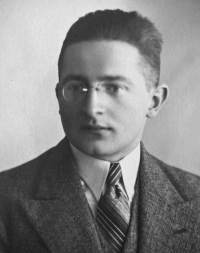
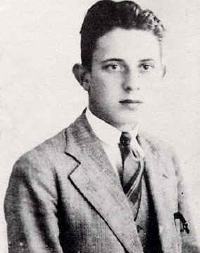
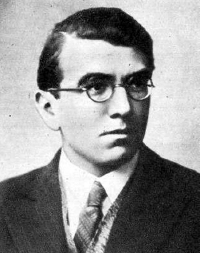
Their success was based on pure mathematical analysis, assisted past data from a High german spy by the proper noun of Hans-Thilo Schmidt (codename Asche), and a commercial Enigma intercepted in the Smooth mail. They then bought a commercial Enigma and used the gathered information to convert it into a armed services i. This converted auto is commonly known as the Smooth Enigma.
| From 1930 onwards, the Germans had been using a very uncomplicated key management scheme, in which the randomly chosen message key was sent twice in encrypted grade at the beginning of each bulletin. This immune the daily key to be recovered relatively easy with paw methods. On 1 October 1936, the Germans stopped using half dozen Steckern and started using v to 8 of them. This defeated the paw methods and the Poles thought out a catalog assail based on the wheel length of the indicator permutations. Rejewski subsequently developed a car to assistance in building the itemize: the Cyclometer. |
|
![Rejewski's Cyklometr. Image supplied by CODEBREAKERS.EU [10]. Click for further information.](https://www.cryptomuseum.com/crypto/bombe/../cyclometer/img/cyklometr_small.jpg)
The catalog independent the length and number of cycles for all 17,576 positions of the wheels for any possible bike social club. Every bit at that place were three wheels at the time, there were half dozen possible wheels orders (3 x ii ten ane), giving a full of 105,456 catalog entries. Building the catalog took well over a twelvemonth, but when information technology was ready, it immune the message key to be recovered in most 15 minutes.
| On 1 November 1937, the Germans replaced the existing reflector (UKW A) for a new one (UKW B), and the Poles had to build a completely new catalog, which would probably take some other twelvemonth. And so, on 15 September 1938, the Germans entirely inverse the procedure for enciphering the message keys, and the catalog method had become completely useless. This prompted the Poles to come up with new solutions, such every bit the Zygalski Sheets and the Bomba Kryptologiczna (cryptologic flop), oft abbreviated to Bomba. The Bomba is based on the principle that the random 3-letter of the alphabet bulletin key is sent twice at the kickoff of each message and that every now and so, a detail plaintext letter of the alphabet, yields the aforementioned ciphertext letter three positions further on. As an example, assume the indicator is A WB TWY. We see that the letter West occurs twice in the second position. The codebreakers at Bletchley Park would later call such occurencies females. As both letter groups (AWB and TWY) originate from the same plaintext (east.g. ZXS), we know that the letter X is encrypted into Due west twice with an interval of 3 steps. This is a unique property that tin can only occur with a limited number of settings.According to Rejewski, if enough females were found, the Bomba could be used to recover the current Enigma settings in less than two hours. |
|
![Artist's impression of the Bomba with only one wheel set installed. Image supplied by CODEBREAKERS.EU [10].](https://www.cryptomuseum.com/crypto/bombe/img/bomba_3_small.jpg)
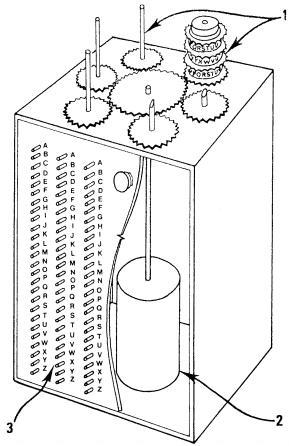
Although all Bomby were destroyed by the Poles in 1939, just earlier the German language Army invaded Poland, Rejewski made a sketch based on his memories many years later on. This sketch appeared in Brian Johnson's book The Secret War in 1978 [1]. An improved version of this sketch appeared in a report of 1979, written by Marian Rejewski himself [2]. This study was provided as an appendix to Władysław Kozaczuk'due south book W kręgu Enigmy [eleven] and was translated into English in 1984 [12].
| The image on the correct 1 shows the improved sketch provided by Rejewski in 1979. The beautiful illustration to a higher place was made by the people behind the CODEBREAKERS.EU website and are based on Rejewski's sketch. It gives a good idea of what the Bomba may have looked like. As the Germans had three different Enigma wheels at the time, there were six possible wheels orders to be considered. This was done past running six bomby in parallel. Each Bomba had 6 full Enigma rotor-sets 2 at its acme (ane), connected in pairs. Each pair was used to solve one (of the three) females.Although the exact performance of the Bomba is still unknown, many have tried to explain its principle by reconstructing a theoretical model. A plausible try was made by David Link in Cryptologia in 2009 [3]. For the recovery of the Ringstellung, the plug board configuration (Steckerbrett) does non have to be taken into business relationship as information technology doesn't move during the encipherment. All that matters is that the same input alphabetic character produces the same result twice, three steps apart. In [3] Link describes a simple method to solve the Steckern in one case the wheel gild and the Ringstellung have been recovered. |
|

Turing-Welchman Bombe Based on the information presented by the Poles, British mathematician Alan Turing developed a motorcar that was capable of recovering the key settings even if the Germans would driblet the double encryption of the message key at the beginning of each message. The motorcar was called Bombe (later: Turing-Welchman Bombe) and was built by the British Tabulating Car Company (BTM) in Letchworth, Hertfordshire (United kingdom) under supervision of Harold (nicknamed Doc) Keen [4].
| The name was derived from Bomba, a similar machine developed past the Poles soon before the outbreak of WWII. The Bomba exploited the fact that the same message indicator was sent twice at the start of each message, a major flaw in the German cryptographic procedures. Although the Bomba concept was known to Bletchley Park, Turing took a different approach. When the Germans had discovered the weakness they gave upward the double encipherment of the message indicator on most radio networks on one May 1940 1 rendering the Bomba useless [nine]. |
|
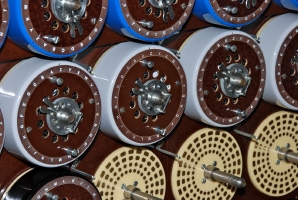
Shortly later on, the Bombe was improved past adding the so-called diagonal board – an invention of young man codebreaker Gordon Welchman – which greatly reduced the number of steps needed for the codebreaking effort. A 2d Bombe, with Welchman'south diagonal board present, was installed on 8 Baronial 1940. It was named 'Agnus Dei', afterwards shortened to 'Agnes' or 'Aggie'. The beginning machine (Victory) was later modified with a diagonal board as well. During the course of the war, over 200 Turing-Welchman Bombes were built. To avoid the adventure of losing them in case of a bomb assail, they were spread betwixt Bletchley Park and its so-called Outstations in Wavendon, Adstock, Gayhurst, Eastcote and Stanmore, where they were operated by WRNS, RAF-technicians and civillian personnel [3].
Turing designed the British Bombe in 1939. Compared to the Polish Bomba, information technology used a completely unlike arroyo. It was based on the assumption that a known (or guessed) plaintext, a so-called crib, is present at a certain position in the message. The Bombes were built by the British Tabulating Company (BTM, later: ICL) at Letchworth (Great britain) nether the supervision of Harold 'Physician' Corking [i]. The start machine, chosen 'Victory', was delivered at Bletchley Park on 18 March 1940.
Like the High german Wehrmacht (Regular army) and Luftwaffe (Airforce), the Kriegsmarine (Navy) used a three-cycle Enigma machine with Steckerbrett (plug-lath). The Navy chosen information technology the M3. Unlike the Wehrmacht and the Luftwaffe however, the Navy used additional codebooks for shortening their messages. The shorter their radio broadcasts, the smaller the risk of Direction Finding (DF). Because Admiral Karl Dönitz, head of the U-Boat department of the High german Navy had his doubts, 3 extra wheels were introduced (VI, VII and VIII), exclusively for the Kriegsmarine. Merely that wasn't all he changed. On ii February 1942, completely out of the blue, the German Navy introduced the Enigma M4, a iv-bike machine, exclusively for U-Boat communication. At the same time they changed their codebooks, leaving the codebreakers at Bletchley Park in the dark.
| The Enigma M4 had an extra rotor, called the Zusatzwalze (extra bike), inserted between the 3rd bicycle and the Umkehrwalze (reflector). As the Bombe was built specifically for breaking three-wheel Enigma traffic, information technology was not suitable for attacking the new M4 automobile. Plain, Dönitz, had managed to defeat the logistic nightmare of replacing all existing M3 machines by the new M4. But every bit the lawmaking was changed overnight, and the rest of the Navy was nonetheless using the 3-wheel car, Turing figured that the machines were somehow compatible. |
|
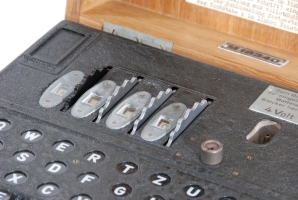
He turned out to exist right. When the 4th bike was set at 'A', the motorcar would comport like the erstwhile M3. This was done, for case, when communicating with the Naval Weather Service. Furthermore, the quaternary wheel never moved during encypherment, making it effectivelty a selector betwixt 26 different reflectors (UKW). Turing soon managed to recover the full wiring of the actress wheel, but was in desperate need for new codebooks in order to read the U-Boat traffic.

In the issue it took until 30 Oct 1942 – nearly nine months afterwards the introduction of the M4 on ii February 1942 – before new codebooks were captured. In the meantime, some of the existing 3-wheel Bombes had been adapted for attacking four-wheel Enigma traffic and orders were given to Doc Bang-up at BTM for the development of an enhanced Bombe that could handle the quaternary bike. ➤ More than about the British Bombe (off-site)
Although the British 4-cycle Bombe worked every bit expected, it faced many problems. At this stage of the war, Great Britain had shortages of nearly everyhing. Equally a result, BTM was unable to deliver enough machines in time and the machines that were delivered oft exhibited contact problems. Ever since their interest in the war in 1942, the Americans had been pushing the Brits to share their knowledge about the Bombe and allow them to copy its design. Finally, in late 1942, when the British 4-bike Bombe was facing production problems and the daily losses in the Battle of the Atlantic were accumulating, the Brits gave in, and allowed the Us to build its ain Bombe.
| The U.s.a.-Bombe was congenital past the National Cash Registers (NCR) in Dayton (Ohio, Us), where information technology was adult by Joe Desch. Initially, the U.s. Navy wanted him to develop a fully electronic machine, just Desch institute this to be impractible, equally information technology would require the machine to take more lxx,000 thermionic valves (vacuum tubes). Towards the end of 1942, Desch proposed a less elegant merely more realistic approch: an electromechanical machine – like to the UK Bombe – but much faster and more than reliable as well. The US Navy immediately approved the projection. |
|
![Photograph copyright NSA [5]](https://www.cryptomuseum.com/crypto/bombe/img/us_bombe_small.jpg)
Desch set out to build the automobile and had the first prototypes running by mid-1943. Although the initial blueprint faced reliability issues, he managed to amend it considerably. In the cease, the United states Bombe turned out to be very reliable, fast and constructive. By December 1943, 120 machines had been installed. For the remainder of the war, the US managed the breaking of the bulk of German Naval Enigma traffic and in particular the messages of the dreaded German U-Boats.
| Afterward the war, information technology became articulate that the US Bombe had helped to save thousands of man lives. Unfortunately however, information technology had destoyed that of Joe Desch – its creator – who suffered a nervous breakup from which he never actually recovered. His girl – Deborah Anderson – has created a website to honor the piece of work of her begetter and his collegues at the Navy Department of NCR [iv]. After the war, all Usa Bombes were destroyed, except for one unit which has since become a permanent exhibit a the National Cryptologic Museum (NCM) at Fort Meade (MD, United states) [5]. |
|
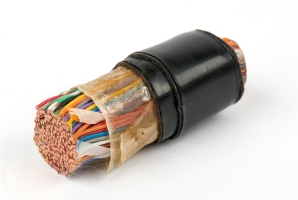
None of the buildings at the old NCR site in Dayton (Ohio, United states of america) take survived. They were taken down only earlier NCR moved its head office to Atlanta in 2009. All that reminds us of the highly cloak-and-dagger work that was carried out in Edifice 26 past Joe Desch and his squad, is the piece of multi-conductor telephone cable shown above. It was recovered from the demolition site on 25 May 2008 by Tom Perera, and was used during the war to bear the confidential conversations about the blueprint and manufacture of the United states Bombe, between the rooms of the secret Navy Section [14]. ➤ More about the Dayton codebreakers (off-site)
In the UK, all British Bombes were destroyed or dismantled once the war was over. As far as nosotros know, non a single machine has survived. This has triggered a group of enthusiasts - led by John Harper - to start a rebuilding project in the mid-1990s. The aim of the projection was to recreate a fully functional replica of a state of war-fourth dimension Bombe machine, which was completed in 2007 [2].
| The completed machine was on public brandish for many years at the Bletchley Park Museum as role of the permanent exhibition in B-Cake, simply was relocated in 2018 to The National Museum of Calculating (TNMOC) which is also located at Bletchley Park. It is demonstrated on a regular basis and can interruption real wartime messages. The prototype on the right was taken at the 2009 Enigma Reunion at Bletchley Park, where the Bombe was demonstrated by John Harper. For further information, please visit John Harper's special website of the Bome Rebuild Projection [ii]. |
|

Delight note that different versions of the Bombe be. Furthermore, a number of attachments and 'special versions' were built for specific tasks and experiments. The version reconstructed past the Bombe Rebuild squad is the after iii-wheel 36-Enigma version, with high-speed Siemens-type sense relays. During the war, 69 of such machines were built. Information technology is featured in the video below.
This video shows the reconstructed Bombe in activeness. Information technology was made during the Enigma Reunion at Bletchley Park in 2009, when project director John Harper was giving live demonstrations. Some of the moving parts inside the Bombe are clearly visible. The video likewise shows the Checking Machine and a British Typex goose egg auto that was converted to deed as an Enigma car.
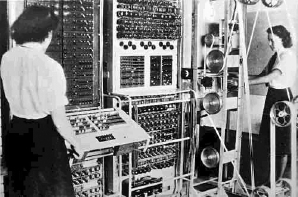
| It is sometimes idea that Enigma was cleaved with aid from Colossus, the first valve-based electronic digital computer, that was adult at Bletchley Park during WWII. Information technology is even claimed in some books and TV documentaries. This merits is not right yet, as Colossus was used to suspension the far more avant-garde Lorenz SZ-40/42 zero automobile, that was used by OKW, Hitler'due south High Command. ➤ More about Colossus |
|
| Bomba | Smooth pre-WWII machine for breaking Enigma-encrypted messages. | |
| Bombe | British, and afterwards too American, WWII machine for breaking Enigma-encrypted letters. | |
| BP | Bletchley Park The United kingdom of great britain and northern ireland'due south WWII code-breaking centre. ➤ More | |
| BTM | British Tabulating Machine Company British manufacturer of volume-keeping machines. During WWII, also the manufacturer of the British Turing-Welchman Bombe code-breaking machines. ➤ Wikipedia | |
| NCR | National Cash Registers American manufacturer of cash registers. During WWII, likewise the developer and manufacturer of the Bombe lawmaking-breaking machine for the Us Navy. ➤ Wikipedia | |
| RAF | Purple Air Force The United Kingdom'southward aerial warfare forcefulness. ➤ Wikipedia ➤ Homepage | |
| TNMOC | The National Museum of Computing British museum about the history of computing, located on the same premises as the Bletchley Park Museum. Also home to the WWII Colossus and Bombe code-breaking machines. ➤ More | |
| WRNS | Women's Regal Navy Service Women'south co-operative of the United Kingdom'due south Royal Navy. ➤ Wikipedia |
1978, BBC.
Mathematical foundations of the German Enigma cipher machine solutions (Shine)
Rejewski'south study of 1979.
Cryptologia, Volume 33, Effect 2, April 2009, pp. 166-182.
ISSN: 0161-1194
ISBN: 0-947712-42-nine
Website, showing the progress and the diverse stages of the project.
Retrieved November 2012.
Website by Deborah Anderson.
Based in Fort Meade (U.s.) about the NSA building.
Cryptologia 10(3), 1986, pp. 134-141.
Website CODEBREAKERS.Eu. Received June 2016.
1979. ➤ Translated into English in 1984 [12].
and How Information technology Was Read by the Allies in World War Two. ane
Translated from [11] and edited by Christopher Kasparek.
thirty June 1984. ISBN 978-0-31327-007-9 (first edition).
US edition: ISBN 978-0-89093-547-7 (2nd edition).
Seahorse and other Kriegsmarine Naught Blunders
Cryptologia 28(3), 2004, pp. 211-241.
Recovered from the demolition site. With document.
Dayton, Ohio, USA. 25 May 2008.
DOWNLOAD HERE
Posted by: taverasthivalt1947.blogspot.com


0 Komentar
Post a Comment